Sizing & Selection · November 17, 2026
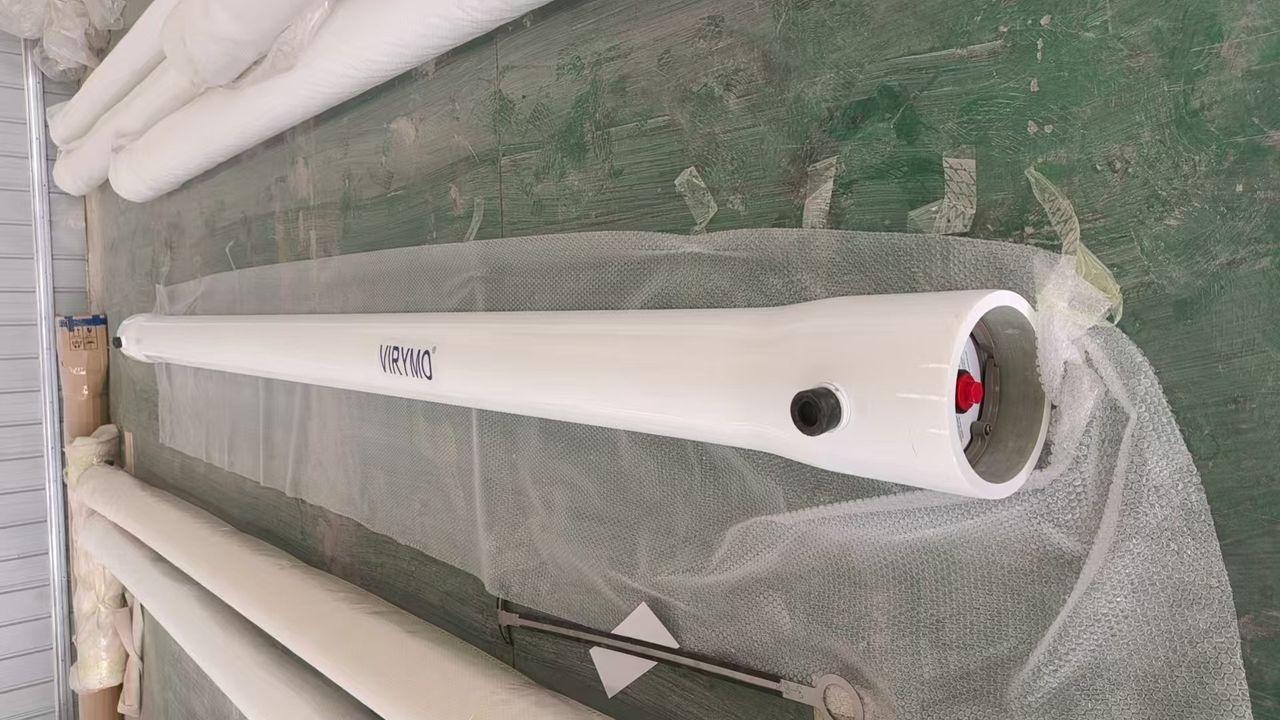
Order a membrane housing with too small a diameter and the element does not fit. Order it with too low a pressure class and it may pass every test in the workshop - and still fail two years into service, at four in the morning, when the high-pressure pump dead-heads against a closed valve. Pressure class is the first decision to fix on an FRP (fibreglass) RO housing, and it is the one buyers most often copy from a previous project instead of calculating.
This guide covers how the four standard classes are built and tested, which duties each one actually fits, and the four numbers you need before you can be sure which class your plant really requires.
The class is the maximum continuous working pressure the vessel is designed and certified for, not the normal operating point. Every vessel we ship is hydrostatically tested well above its rated class before leaving the workshop, and the CE marking on the end cap refers to that rated pressure. The four classes we build for 4040 and 8040 elements:
| Pressure class | Metric equivalent | Typical duty |
|---|---|---|
| 300 psi | 2.07 MPa | Brackish-water RO on municipal or well water, commercial RO, most two-stage industrial trains at standard recovery |
| 450 psi | 3.10 MPa | Higher-TDS brackish feed, high-recovery systems, wastewater reuse, plants with long feed runs or oversized pumps |
| 600 psi | 4.14 MPa | High-pressure brackish and speciality process trains, high-recovery seawater second pass, mobile / containerised units with aggressive pump curves |
| 1000 psi | 6.89 MPa | Seawater desalination first pass (SWRO) and other duties where feed pressure itself approaches the vessel limit |
Most of the quotations we receive are correctly served by 300 psi; the errors run in both directions - undersizing a high-recovery train, or paying for 1000 psi on a plant that will never see 250.
Working rule: pick the class above the highest of these four numbers, with sensible margin - not just above the steady-state operating point. If your calculation lands between two classes, take the higher one; the price difference is small next to the cost of a failed vessel.
Our FRP housings take 4040 and 8040 RO membrane elements, from 1 to 7 elements per vessel. Element count per pressure vessel is set by the system designer (array design), but the vessel length, port positions and internal adapters must match it - a 4-element 8040 vessel is a different order from a 6-element one, even at the same pressure class.
If you are still fixing the vessel size itself, our membrane housing sizing guide walks through element count and array layout before the pressure decision.
The pressure class is rated at ambient temperature. The limit that matters at temperature is the resin system, not the glass fibre: our standard vessels are rated for continuous service from 20 F to 120 F (-7 C to 49 C). Above that range, tell us at enquiry stage - we will quote a higher-temperature resin or recommend a stainless vessel for hot-sanitised duties. The full material trade-off is in our FRP vs stainless steel membrane housing comparison.
Chemistry is where FRP shines: the filament-wound composite shell does not corrode, even in seawater, and weighs about a quarter of the equivalent stainless vessel - which matters for containerised plants, rooftop installations and freight costs.
| Mistake | Consequence | Fix |
|---|---|---|
| Class chosen on operating pressure only | Vessel overstressed at pump dead-head | Class above the highest of operating / dead-head / back-pressure / transient |
| 300 psi on a high-recovery brackish train | Class upgrade mid-project, new pipework | Calculate at design recovery, not feed-water brochure figures |
| Vessel length not matched to element count | No room for adapters or thrust ring | State element count per vessel on the PO |
| Hot CIP at 60 C into a standard resin vessel | Resin softening, weeping at ports | Declare maximum temperature at enquiry; upgrade resin or go stainless |
| EPDM O-rings with hydrocarbon-contaminated feed | Swollen, leaking seals | Viton O-rings where chemistry demands it |
| Ports ordered to match the old vessel | Pipework rework on installation | Confirm port sizes and entry type against the new skid drawing |
We filament-wind our own VIRYMO FRP housings for 4040 and 8040 elements in all four pressure classes - see the FRP membrane housing product page for specifications and the FRP membrane housing manufacturer page for tooling, testing and export packing. If you are comparing materials, the stainless steel 4040 / 8040 housings and our membrane housing price guide put both families side by side.
Send us the feed-water analysis, design recovery and pump model, and we will confirm the pressure class, vessel length and port configuration before quoting - including the accessories list so the housings arrive ready to mount.
Related products: 4040 / 8040 FRP membrane housings 300-1000 psi · FRP membrane housing manufacturer · 4040 RO membrane elements · FRP vs stainless steel membrane housing