Material Selection · November 10, 2026
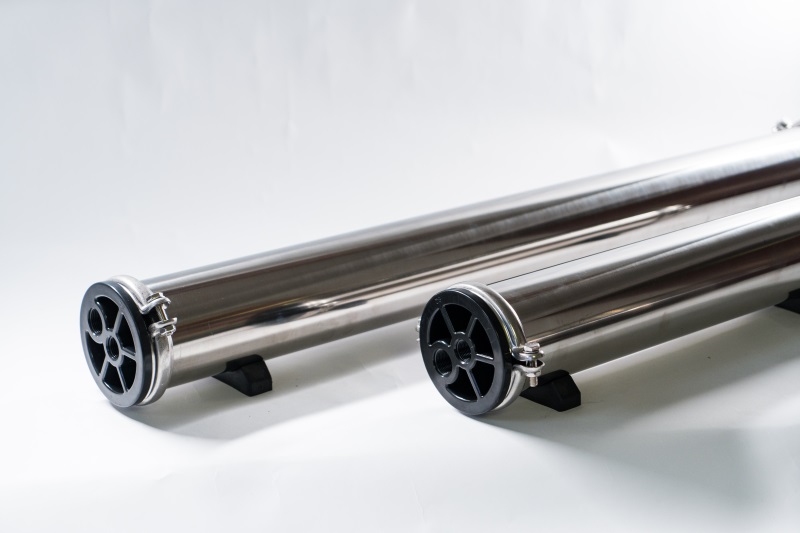
Almost every RO or ultrafiltration project reaches the same fork in the road: do we specify FRP membrane housings or stainless steel ones? Both hold a standard 4040 or 8040 element, both are pressure vessels, and on paper the price difference looks small. In service the difference is large - one may run twenty years untouched, the other may pit through in three.
This guide sets out the six factors that actually decide it, with a duty-by-duty table at the end.
The important point is that these are two different engineering philosophies, not two grades of the same product. FRP is a corrosion barrier that happens to be strong. Stainless is a strong material that happens to resist corrosion - until the passive layer breaks down.
FRP housings are usually selected by pressure class, and the class must cover the maximum pressure the vessel will ever see - including the pump dead-head pressure and any permeate-side back pressure, not just the normal operating point. A 300 psi housing on a system that occasionally runs to 350 psi is a warranty argument waiting to happen.
Stainless housings are built to a design pressure with a hydrostatic test at 1.5 times design, so the rating is explicit and traceable in the test report. If your process needs a documented pressure vessel certificate or a third-party inspection, stainless is the simpler route.
For most brackish water RO at 200 to 300 psi operating pressure, a 300 psi FRP housing is correctly rated and is the cheapest sound answer. Seawater RO at 800 to 1000 psi narrows the choice to high-pressure FRP or heavy-wall stainless.
This is the decisive factor in most real projects. FRP has no metal to corrode. It does not care about chloride, and it does not care about the concentrate line where chloride is three to five times higher than in the feed.
Stainless steel does care. SS304 will pit in chloride-bearing water, especially in stagnant or low-flow conditions and at welds where the passive layer was disturbed. SS316L with molybdenum resists far better, but it is not immune - and the higher the chloride and temperature, the shorter the life. On a seawater or brackish application, the honest comparison is not FRP versus SS304, it is FRP versus SS316L with pickling and passivation, which erases much of the price gap.
One practical warning: stainless failures usually start where nobody looks - under a clamp, inside a weld toe, or in a dead leg that never drains. If your water is chlorinated and the skid sits idle for weeks, expect trouble.
Standard epoxy FRP housings are comfortable to about 49 C (120 F), with high-temperature grades reaching roughly 65 C. Above that, the resin starts to lose mechanical strength, and the rating must be derated.
Stainless steel has no such limit within normal water treatment ranges. Hot water sanitisation at 80 to 85 C, CIP at 70 C and high-temperature process lines all point to stainless. If your sanitation procedure is hot water rather than chemical, this single line decides the specification.
For purified water, WFI, injectable-grade loops, dairy, beverage and any line with a microbiological specification, specify stainless steel. It can be polished to Ra 0.8 um or finer, fully drained, steam or hot-water sanitised, and inspected inside. FRP cannot be polished to a sanitary finish and its liner is not intended for repeated hot sanitisation.
FRP remains perfectly acceptable for the RO stages upstream of a sanitary loop, and it is common to see an FRP first stage feeding a stainless polishing stage. Mixing materials by duty is normal engineering, not a compromise.
A 40-inch 8040 FRP housing weighs roughly half of its stainless equivalent, and that difference matters more than it sounds. It reduces rack steel, allows single-person handling during element change-out, and makes rooftop and containerised installations far easier. On skids that ship assembled, the weight saving also reduces freight cost.
Stainless housings need proper support at both ends and allowance for thermal expansion on hot lines. FRP needs support too, but the loads are lower.
For a 4040 vessel the two options are close in price. For an 8040 vessel FRP is usually clearly cheaper per vessel, and the gap widens at higher element counts. But the fair comparison adds:
Over ten years, on clean low-chloride water, stainless often wins on total cost because it never needs replacing. On aggressive water, FRP wins because the stainless option was under-specified to begin with.
| Duty | Recommendation | Reason |
|---|---|---|
| Brackish water RO, 200-300 psi, TDS under 3000 mg/L | FRP 300 psi | Correctly rated and lowest installed cost |
| Seawater RO, 800-1000 psi | High-pressure FRP, or SS316L | FRP for cost, stainless where a vessel certificate is required |
| Food, dairy, beverage, bottled water | SS316L, polished | Sanitary finish and cleanability |
| Pharma PW / WFI, injectable water | SS316L, Ra 0.8 um or finer, hot sanitisation | No resin, fully drainable, documented |
| High chloride feed or seawater concentrate line | FRP, or SS316L with passivation | Pitting risk rules out SS304 |
| Hot water sanitisation at 80 C or above | Stainless steel | Resin temperature limit |
| Rooftop, containerised or skid-mounted plant | FRP | About half the weight |
| Municipal and boiler feed water, low chloride | SS304 or FRP | Either works; choose on documentation and service access |
| Pilot line or laboratory unit | FRP 4040 | Lowest cost per test programme |
| Chemical dosing or acid/CIP duty | SS316L, or FRP with compatible liner | Depends on the chemical; confirm resin compatibility |
We build both sides of this comparison, so we have no reason to push one. Our SS304 and SS316L membrane housings cover 4040 and 8040 elements in side-entry and end-entry designs, with sanitary polish available; the 8-inch 8040 stainless vessel page covers multi-element configurations. For FRP, see our FRP membrane housing range from 300 to 1000 psi, and the stainless housing manufacturer page for capacity, lead times and export packing. Indicative pricing for both families is in our membrane housing price guide.
Send us the feed water analysis (TDS, chloride, temperature), the operating pressure and the element size, and we will tell you which of the two we would specify for that duty - and quote both so you can compare.
Related products: SS304 / SS316L 4040 and 8040 membrane housings · FRP membrane housings 300-1000 psi · stainless membrane housing manufacturer · membrane housing price guide