Sizing & Selection · November 19, 2026
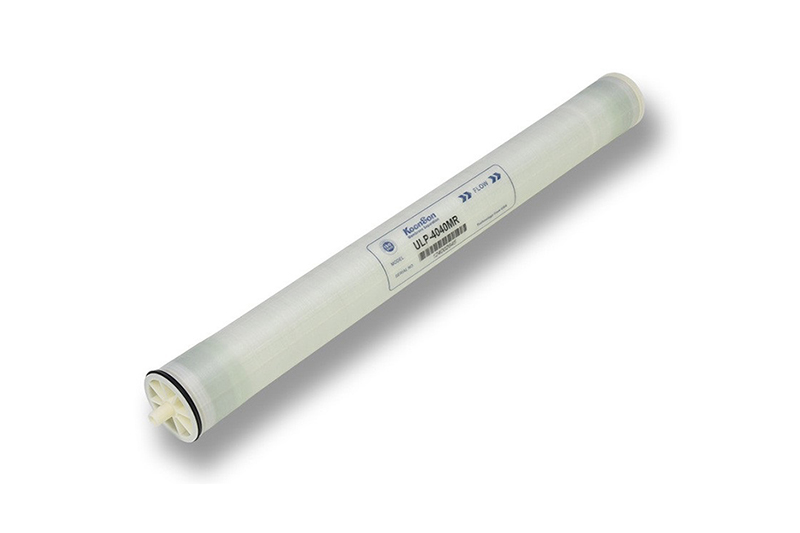
Almost every RO enquiry we receive ends with the same two questions: 4040 or 8040? and how many elements do I need? The answers decide the membrane housing count, the frame size, the pump duty and - more than any other single choice - the capital cost of the plant. Get them wrong and you either pay for vessels you do not need or run elements outside their design flux and replace them every year.
This guide compares the two standard element sizes on the numbers that matter, shows how to convert a required permeate flow into an element count, and explains how to tell the difference between a membrane that needs cleaning and one that needs replacing.
The figures are dimensions in inches. 4040 is a 4 inch diameter, 40 inch long element. 8040 is 8 inch diameter, 40 inch long - the same length, twice the diameter. Because membrane area scales with the surface wrapped inside the element, the 8040 carries roughly four to five times the area of a 4040 in the same length.
| Property | 4040 (4 inch) | 8040 (8 inch) |
|---|---|---|
| Nominal dimensions | 4 in x 40 in (approx. 100 x 1016 mm) | 8 in x 40 in (approx. 200 x 1016 mm) |
| Active membrane area | About 7.5 - 8 m² (80 - 90 ft²) | About 37 m² (400 ft²) |
| Typical permeate per element, brackish water | 1,800 - 2,600 GPD (7 - 10 m³/day) | 9,000 - 12,000 GPD (34 - 45 m³/day) |
| Elements per 6-element vessel | 6 (single-element and 2-3 element vessels also common) | 6 standard; 4, 5 and 7 element vessels available |
| Housing family | 4040 stainless steel or FRP vessels | 8040 stainless steel or FRP vessels |
| Where it fits | Small and medium plants, lab and pilot skids, single-stage polishing, tight plant rooms | Industrial plants from roughly 10 m³/h permeate upwards, seawater and large brackish systems |
The 8040 is not "better" - it is bigger. It wins on cost per cubic metre of installed capacity because one vessel and one set of ports carries four times the area. The 4040 wins on handling, on turndown and on installations where a 2 m long, 60 kg element cannot be lifted or manoeuvred.
Every element datasheet quotes a permeate flow, and buyers routinely treat it as the flow they will get on site. It is not. The number is measured under standard test conditions: roughly 25 °C, 250 - 2,000 ppm NaCl feed, 15% recovery, a set pressure and a stated pH. Change any of those and the real output moves.
For brackish water, design permeate flux is normally held to about 15 - 20 litres per square metre per hour (LMH). Seawater elements run lower, around 12 - 15 LMH, to keep fouling under control. Use those figures for the element count below - not the datasheet GPD.
Worked example: a plant needs 20 m³/h of permeate, brackish feed, design flux 18 LMH.
Now count the hardware. With 6-element vessels that is about 24 vessels of 4040 against 5 vessels of 8040. Each vessel needs a pressure port in and out, a permeate connection, saddles and space on the frame - so the 8040 layout needs a fraction of the pipework, valves, instruments and floor area. That is why above roughly 10 m³/h almost every industrial plant standardises on 8040.
| Permeate duty | 4040 elements (approx.) | 8040 elements (approx.) | Typical choice |
|---|---|---|---|
| 0.5 - 2 m³/h | 6 - 18 | 2 - 4 | 4040 - small skid, single operator, low budget |
| 2 - 10 m³/h | 18 - 90 | 4 - 16 | Either; 4040 in containerised or retrofit plants |
| 10 - 50 m³/h | 90 - 450 | 16 - 70 | 8040 - vessel count and pipework dominate cost |
| above 50 m³/h | not practical | 70+ | 8040 in multi-stage arrays |
Element count is only half of it. Elements are arranged in pressure vessels, and vessels are arranged in stages: the concentrate from the first stage feeds the second, which raises overall recovery without pushing individual elements past their flux limit. A common brackish layout is 2:1 - two thirds of the vessels in the first stage, one third in the second.
Two practical constraints follow:
Our stainless steel 4040 / 8040 membrane housings and VIRYMO FRP housings are both built to 1 - 7 elements per vessel, in 300 / 450 / 600 / 1000 psi classes; the membrane housing sizing guide covers port configuration and closure choice, and the pressure class guide explains how to pick the rating from your pump curve.
Membranes do not fail suddenly. They degrade, and the degradation shows up in three measurable trends once performance is normalised to standard temperature and pressure. Track them monthly and replace on evidence:
| Indicator | Replace trigger | What it usually means |
|---|---|---|
| Normalised permeate flow | Down more than 15% from commissioning | Fouling, compaction or scaling that cleaning no longer recovers |
| Normalised salt passage | Up more than 15% (rejection down about 10%) | Membrane oxidation by chlorine, hydrolysis, or O-ring / glue-line damage |
| Differential pressure per vessel | Up more than 15%, or above the maker's limit | Colloidal or biological fouling, or channel blockage |
Clean first, then re-measure. If a CIP cycle restores flow and rejection, the element stays. If the trend returns within weeks, or rejection never comes back, the element is spent. One more tell-tale: if rejection falls while flow stays normal, look for a mechanical leak - a rolled O-ring or a cracked end cap will pass salt without any fouling signal at all.
Typical service life under good pretreatment is 2 - 3 years; with poor pretreatment it can be 12 months. That is why the elements are only half the purchase: the precision filter housings and bag filtration ahead of them decide how long they last. Our RO pretreatment page covers the full train.
| Mistake | Consequence | Fix |
|---|---|---|
| Sizing element count from datasheet GPD | Plant runs above design flux, fouls early | Size on 15 - 20 LMH design flux (brackish) |
| Choosing 4040 for a 30 m³/h plant to save on elements | 200+ elements, dozens of vessels, unmanageable pipework | Compare total installed cost, not element price |
| Ordering "8040 housings" without stating elements per vessel | Shell length and port spacing wrong | State elements per vessel, pressure class and port type |
| No temperature correction in winter | Output falls 25 - 30%, product quality alarms | Design at the coldest feed temperature, or preheat |
| Replacing elements before trying a CIP | Spend on membranes that were recoverable | Clean, re-normalise, then decide |
We supply 4040 polyamide composite RO membrane elements alongside the vessels they run in - stainless steel 4040 / 8040 housings and filament-wound FRP membrane housings - plus the cartridge and FRP tank stages ahead of them. As a manufacturer we can match element count, vessel length, port layout and pressure class in one order, so the skid goes together without adapter surprises.
Send us the permeate flow, feed analysis and the coldest feed temperature, and we will come back with an element count, a vessel list and the pressure class behind it - with the alternatives priced so you can see the 4040 and 8040 total installed cost side by side. The membrane housing price guide explains what drives the vessel quotation.
Related products: 4040 RO membrane elements · SS 4040 / 8040 membrane housings · VIRYMO FRP membrane housings · Membrane housing price & lead time guide